The journey didn’t begin in a laboratory, but on the airframes of supersonic jets. In the 1960s, engineers at Dornier System noticed that planes flying at high speeds through rain experienced mysterious “pitting” on their metal shells. They discovered that the impact of raindrops at supersonic speeds created kinetic shock waves, physical energy that could travel through a solid and cause stress at the interface.
This sparked a radical vision: if a shock wave can travel through an airplane’s skin and crack the structure beneath, could it travel through human tissue, which is mostly water, and crack a kidney stone without harming the patient?
The hypothesis was bold. It required a medium with the same acoustic impedance as the human body to allow the wave to pass through the skin without releasing its energy prematurely. This led to the early experiments in Munich, where the first patients were famously submerged in a “bathtub” of water to facilitate this transfer of energy.
Breakthroughs: Mastering the Physics
To move from vision to reality, we had to master the physics of two specific mechanisms that most people, and even some medical texts, overlook: Spallation and Cavitation.
- Spallation: When a shock wave hits the front of a stone, it reflects off the back surface. This creates internal tensile stress, effectively crumbling the stone from the inside out.
- Cavitation: This is the “secret weapon” of ESWL. The passage of the wave creates thousands of microscopic vacuum bubbles in the surrounding fluid. When these bubbles collapse, they release secondary “micro-jets” of energy that pulverize the remaining fragments into fine sand.
The clinical reality arrived on February 7, 1980, when Dr. Christian Chaussy treated the first human patient using the Dornier HM3. It was a watershed moment. Within four years, the FDA granted approval, and the standard of care for urolithiasis changed overnight.
The Reality: Why ESWL Still Matters
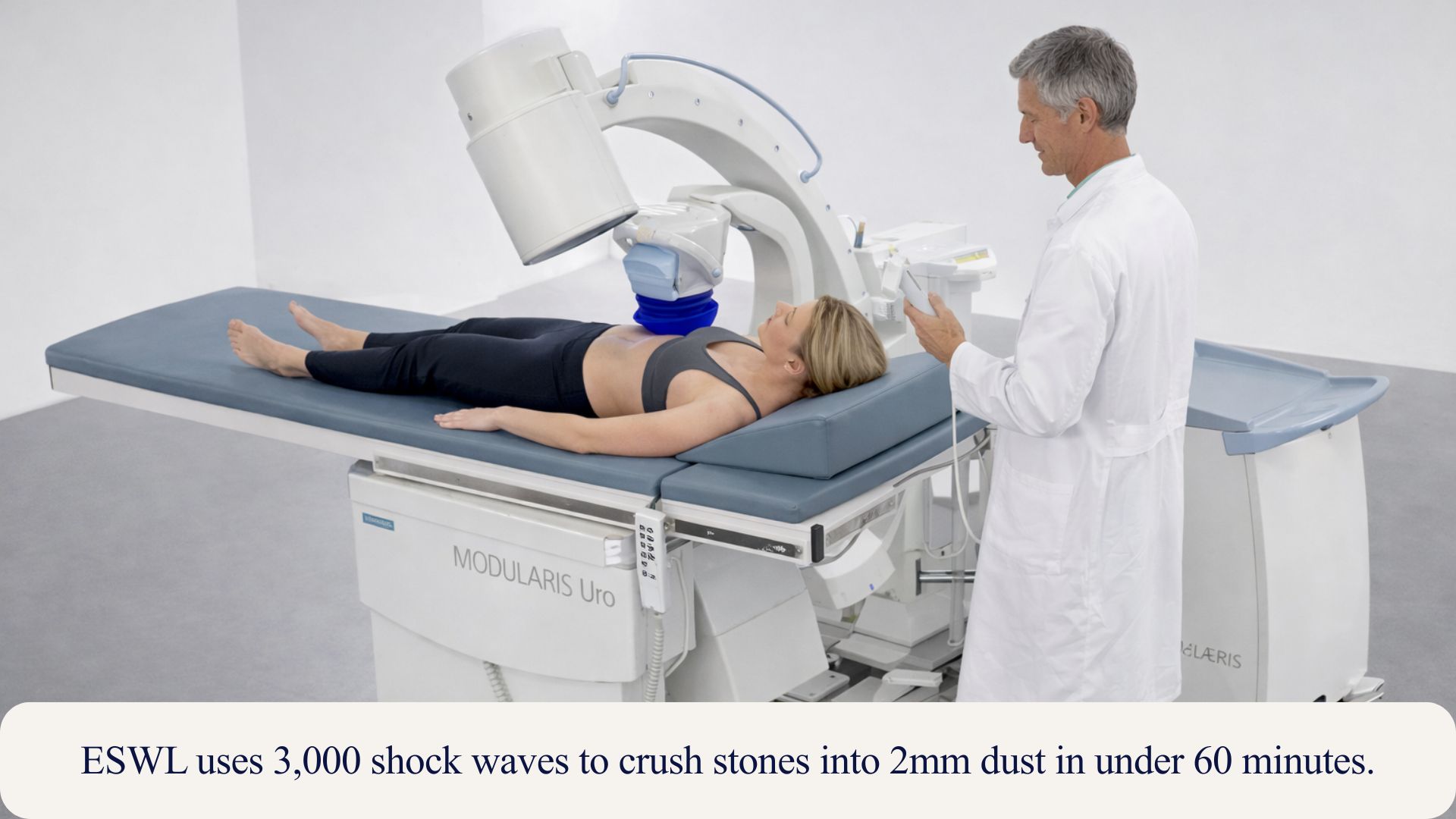
Today, we have moved beyond the “bathtub.” Modern lithotripters use electromagnetic and piezoelectric generators that are compact and precise. While newer technologies like Ureteroscopy (URS) and Retrograde Intrarenal Surgery (RIRS) have gained popularity, ESWL remains a pillar of my practice for several reasons:
- Non-Invasiveness: It remains the only truly extracorporeal treatment. No scopes, no incisions, and often minimal anesthesia.
- Predictable Success: When we select patients based on the “Triple D” score (Density, Distance from skin, and Diameter), success rates consistently reach 80% to 90% for stones under 10 mm (Source: Journal of Urology).
- Efficiency: Recent data from NCBI StatPearls confirms that serious complication rates, such as significant renal hematoma, remain below 1%, making it one of the safest procedures in the urological arsenal.
The Professional Retrospective
When I look back at the evolution of ESWL, I see more than just a machine. I see a triumph of multidisciplinary collaboration. It took aerospace engineers to understand the physics, physicists to focus the energy, and urologists to apply it to the human condition.
We successfully replaced the trauma of open nephrolithotomy with the precision of focused sound. That is the definition of a medical revolution.
Frequently Asked Questions: Navigating ESWL in India
How much does ESWL treatment cost in India?
- In my experience, the average cost ranges from ₹30,000 to ₹55,000 per session. The final price varies based on the city, the type of lithotripter used, and whether you require a single or multiple sessions. Most private insurance plans in India now cover this as a “day-care” procedure.
Is the procedure painful, or will I have scars?
One of the greatest benefits I highlight to my patients is that ESWL is completely non-invasive. There are no incisions, meaning you will have zero scars. While you might feel a “tapping” sensation, we use mild sedation or local anesthesia to ensure you remain comfortable throughout the 45-minute session.
Is ESWL better than Laser (RIRS) or PCNL?
There is no “one size fits all.” I recommend ESWL for smaller stones (under 1.5 cm) because it is non-surgical. However, for larger or very dense “hard” stones, I might suggest RIRS (Laser) or PCNL for a higher one-time success rate, even though they are more invasive.
How long is the recovery time before I can return to work?
In our fast-paced environment, this is a top priority. Most of my patients walk out of the hospital the same day. I generally advise resting for 24 to 48 hours before returning to your normal routine. You’ll just need to increase your water intake to help pass the fragments.
Are there any specific risks I should be aware of?
While ESWL is very safe, it is common to see mild blood in the urine or feel slight “colic” as stone dust passes. Serious complications are rare, less than 1% in my practice. I always screen for pregnancy or blood-thinning medications first, as these are the main contraindications.